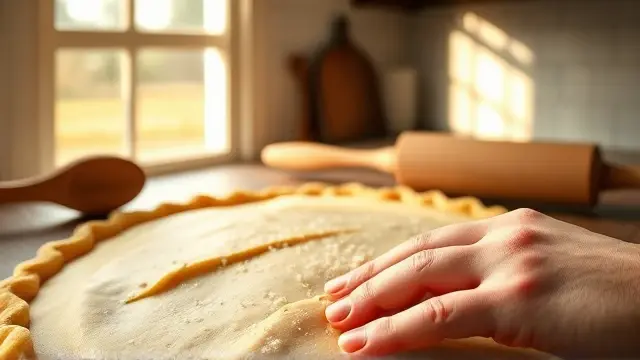
A pie crust that shrinks away from the edges of the pan is an immediate sign that something went wrong before it ever touched the oven. The crust looked fine when you crimped the edges. Then fifteen minutes into baking, it's retreated halfway down the side like a turtle into its shell. This isn't a baking problem. It's a dough problem, and it's almost always fixable.
The Gluten Problem
When you mix pie dough, you're hydrating flour and developing gluten — the protein network that gives dough structure. This is actually useful for bread, where you want elasticity. But for pie crust, gluten is your enemy. An overworked dough with strong gluten bonds wants to contract and spring back, exactly like a rubber band. When that dough is rolled out, stretched into a pan, and then heated, it retracts aggressively toward its rested state.
The first defense is simple: handle the dough as little as possible. Mix until the flour is just barely moistened. Use a food processor if you have one — it takes thirty seconds to reach the right texture. If you're mixing by hand, work in butter with a pastry cutter until you have pea-sized bits. Stop. Add water, mix gently until the dough just comes together. Any further mixing is wasted effort and a gift to shrinkage.
That said, some level of gluten development is unavoidable. Which is why rest time is non-negotiable.
Rest Time Does the Real Work
A pie dough needs to rest after mixing and again after shaping. During rest, the gluten network relaxes. The proteins that are all coiled up and ready to spring back gradually lose that tension. A dough that's been properly rested has no interest in shrinking — the elastic energy has dispersed.
I rest mixed dough for at least one hour in the refrigerator before rolling. After rolling and lining the pan, I rest again for at least thirty minutes. Yes, this adds time. Yes, it's worth it. A pie crust that has rested properly might still shrink slightly, but it won't retreat. It won't pull away from the fluting. It will stay where you put it.
If you're in a rush, thirty minutes at room temperature is better than no rest at all. Cold rest is superior, but movement is movement. The gluten still benefits.
There's a reason why Judy's Easy Pie Crust works for so many people: the method builds in a rest step before rolling and again after shaping. It's not fancy. It's considerate. It respects the physics of the dough.
Blind Baking: The Safety Net
Blind baking — baking the crust partially or fully before adding filling — serves multiple purposes. One of them is forcing the crust to set before it has a chance to shrink further during the full bake. If you're using a custard or cream filling, blind baking is structural. The crust hardens first. Shrinkage is essentially finished before the liquid filling ever goes in.
For a cream pie, blind bake at 400°F for twelve to fifteen minutes with pie weights. You're looking for it to set and hold its shape, not for significant browning. Remove weights and bake another three to five minutes if the bottom still looks wet. You want a matte finish, not glossy.
For a fruit pie, blind bake shorter — just eight minutes. Fruit fillings will release juice as they cook, which will finish cooking the crust. You don't want it fully set or it'll be too hard by the end.
If you don't have pie weights, use dried beans, rice, or even crumpled foil. The goal is to prevent the bottom from puffing up and the sides from collapsing. Support matters.
The Water Temperature Detail
One small thing that matters: ice water. When you add water to pie dough, it should be cold. Cold water is absorbed more slowly, which means less gluten development during mixing. It also keeps the fat from warming up and softening, which would make the dough greasy and impossible to work with. Warm water is a self-inflicted wound. Don't.
Why It Happens Even When You Do Everything Right
Occasionally, crust shrinks despite proper technique. This usually means one of two things. First, the ambient humidity might be extreme — very dry air will cause dough to lose water quickly, which can tighten it. Second, the oven temperature might be wrong. If the crust isn't baking fast enough, it stays warm and pliable for too long, which gives the residual gluten tension time to express itself. Verify your oven temperature with a thermometer. Off-temperature ovens shrink a lot of pies.
If you've rested the dough, handled it gently, and blind baked correctly, shrinkage becomes rare. When it does happen, it's usually the oven. Check the thermometer before you blame your technique.