I'll be honest — I've spent most of my life thinking the farmers market was for people with different grocery budgets. The one in downtown Durham runs Saturday mornings, and every time I'd driven past it I'd see people carrying small paper bags of tomatoes that probably cost what I'd spend on three days of dinners. I wasn't bitter about it. I just didn't see how it applied to me.
Then my friend Carla, who does not have a different grocery budget but does have strong opinions, dragged me there one Saturday in July. She gave me two rules: bring $40 cash so you can't overspend, and don't buy anything you can get cheaper at Food Lion. The second rule eliminated most of the market immediately. Onions, potatoes, carrots, cabbage — the workhorses of my kitchen — are commodity produce. The Food Lion version and the farmers market version are functionally identical, and the farmers market charges twice as much because someone hand-lettered a chalkboard sign.
That narrowed my options, which turned out to be useful.
What I bought
Tomatoes. Four big heirlooms for $6, which is outrageous until you taste one. I sliced one over the sink when I got home because I couldn't wait, and I stood there thinking about every pale, mealy grocery store tomato I'd ever bought in February. These were a different product entirely — dense, warm from the sun, sweet and acidic at the same time, juicy enough to drip down my wrist. Carla had told me this would happen and I hadn't believed her.
A bunch of basil for $2. A small bag of mixed salad greens for $4 — arugula, baby kale, some red lettuce I didn't know the name of. A pint of cherry tomatoes for $3. A cucumber for $1.50 that smelled like an actual cucumber, which sounds like nothing until you realize the ones at the store don't smell like anything at all.
A dozen eggs for $5 from a woman who had pictures of her chickens on the table. These were brown and speckled and various sizes, not the uniform white ovals from the store. I cracked one into a pan when I got home and the yolk was deep orange, almost sunset-colored, and it stood up tall instead of spreading flat. The taste was richer — more egg-like, if that makes sense. Like the difference between fresh coffee and the pot that's been sitting on the burner for three hours.
And a jar of local honey for $8, which Carla said was non-negotiable.
Total: $29.50. Under budget.
What I made
The tomatoes were the revelation, so I built the week around them.
Monday night was the simplest possible dinner: thick slices of heirloom tomato on a plate, drizzled with olive oil, sprinkled with salt, torn basil on top. That's it. I've made gazpacho before and it's fine, but these tomatoes were too good to blend into anything. You'd be hiding the thing that made them worth six dollars.
Marcus looked at his plate and said "this is dinner?" and then ate all of it and went back for more, which is the most honest food review a sixteen-year-old can give.
Tuesday I made a salad with the mixed greens, cherry tomatoes halved, the cucumber sliced thin, and a dressing of olive oil, lemon juice, salt, and a little of the honey. The greens were peppery and tender in a way that bagged salad mix never is — they'd been picked that morning, Carla told me, not three weeks ago in California. I put the leftover sliced heirloom on top. We ate it with some bread and butter and the last of Monday's roasted chicken, and it felt like a meal from a different household. Not fancier. Just more alive.
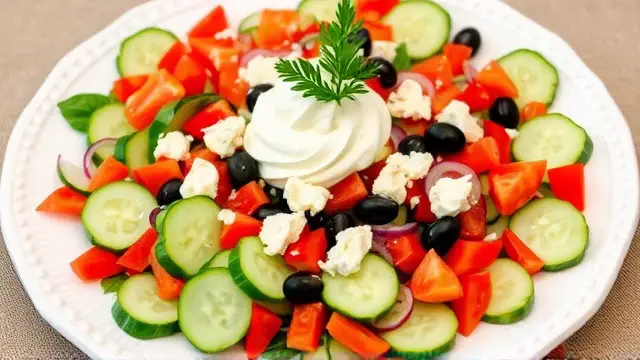
Wednesday I made Elliniki salata — a Greek salad, basically — with the remaining tomatoes, cucumber, some red onion, and feta from the store. The recipe calls for Kalamata olives and I had half a jar in the back of the fridge from something I'd made months ago. With good tomatoes and a fresh cucumber, this salad doesn't need much. Oil, lemon, oregano, salt. It took five minutes and it was the best salad I made all week.
The eggs lasted through the week — scrambled for breakfast, hardboiled for Marcus's lunch, fried on top of rice and beans on Thursday when the farmers market produce was gone and we were back to normal. Even on rice and beans, those eggs made a difference. That orange yolk turning soft over black beans and hot sauce — it turned a $2 dinner into something I actually looked forward to eating.
What I learned
Not everything at the farmers market is worth the price. The potatoes were $3 a pound, and a potato is a potato. The bread was $7 a loaf and I'm sure it was good bread, but I can make bread. The fancy pickles, the artisanal jam, the $12 hot sauce — these are gifts, not groceries.
But tomatoes in July, from someone who grew them twenty miles away and picked them yesterday? That's a different ingredient than what the store sells. It's not a premium version of the same thing. It's a different thing entirely, and it makes everything around it better — the olive oil tastes more like olive oil, the salt does more work, the basil is actually necessary instead of decorative.
The eggs, same. The cucumber, same. The honey I'm still deciding on — it's good, but it's $8 good and I can get a bear-shaped bottle for $4 that works fine in tea.
Carla's rule was right. Don't buy what you can get cheaper elsewhere. Buy the things that are actually, meaningfully different when they're fresh and local. For me, in July, that was tomatoes, eggs, and salad greens. In October it might be apples and squash. In January it's probably nothing, and that's fine. That's what Food Lion is for.
I went back the next Saturday. I brought $30 this time. Marcus came with me and bought a peach with his own money, which he ate in the car on the way home, juice all over the seat. He said it was the best peach he'd ever had. It probably was.